The Decision Problem
When you need dependable linear motion for an automation rig, the first question is whether a cylinder with the right bore and stroke actually fits your space without turning into a maintenance headache. A small mismatch in travel or mounting can throw off an entire sequence, so you want something with predictable dimensions and a construction that can handle repeated cycling. The challenge is finding a unit that balances these basics without adding unnecessary weight or requiring constant attention.
Quick Verdict
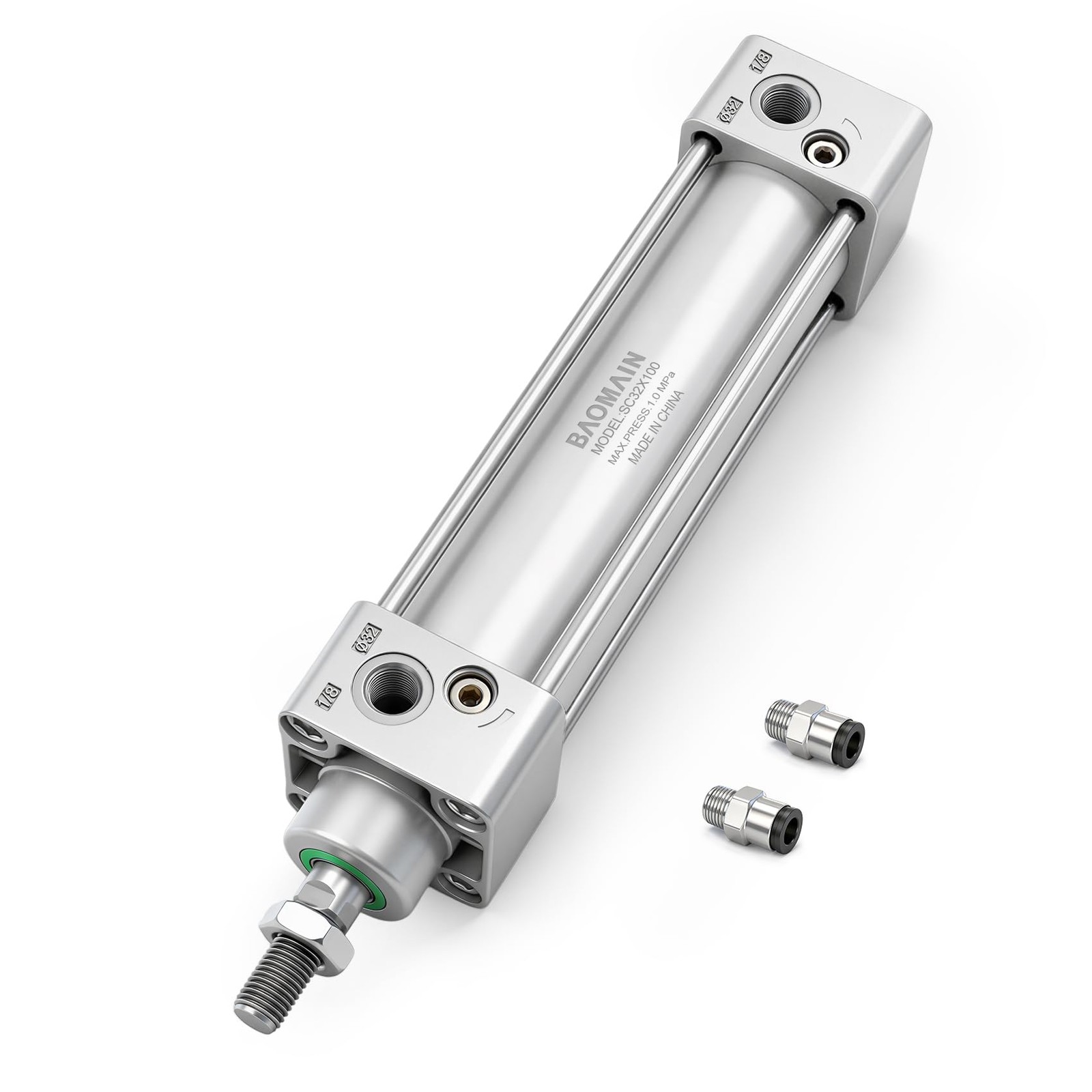
The Pneumatic Air Cylinder 1-1/4\" Bore 4\" Stroke SC32x100 is a practical pick for straightforward push-pull tasks that need a compact double-acting actuator. Its 1-1/4-inch bore delivers moderate force while the 4-inch stroke gives you enough travel for many clamping, lifting, or positioning operations. At USD 28.72, it offers a straightforward specification set that is easy to match to your existing pneumatic system.
Who It Suits
This cylinder suits builders, maintenance teams, and hobbyists who need a no-frills double-acting unit for a linear application. If your design calls for a 32mm-style cylinder with a 100mm stroke and you operate on standard shop air, the SC32x100 is a logical fit. It also appeals to anyone who wants to keep downtime low: the self-lubricating bearing is designed to let the piston rod work without additional lubrication, which simplifies routine upkeep.
What Stands Out From the Listed Details
The listed bore and stroke are the first things that stand out. A 1-1/4\" bore combined with a 4\" stroke gives a useful envelope for compact fixtures. The double-acting design is a key feature because it provides controlled force in both extension and retraction, so you are not relying on a spring to return the rod. That makes the cylinder easier to use for applications that need positive motion in both directions.
The aluminum alloy construction is another notable point. It keeps the cylinder lightweight while still offering corrosion resistance for demanding environments. That matters in industrial settings where moisture or washdowns can shorten the life of steel-bodied components. The low-maintenance design, with its self-lubricating bearing, reinforces the idea that this is meant for continuous use without frequent servicing.
Meaningful Trade-Offs
The trade-off with this cylinder is that it is a standard, no-options unit. There is no mention of adjustable stroke, magnetic piston position sensing, or integrated cushioning in the provided details. If your application needs precise end-position sensing or adjustable speed control at the cylinder itself, you would need to build that into your system externally. Also, while aluminum gives you lighter weight and corrosion resistance, it may not hold up as well as steel in heavy-impact or high-shock applications. The plastic or anodized surfaces described as "silver" in the attributes could show wear if you are constantly cycling at high speeds, though the double-acting design should still provide smooth motion.
Another trade-off to consider is that the listed price reflects a single cylinder. You will need to factor in fittings, air lines, and a control valve if you are assembling a circuit from scratch. The bore size is not adjustable, so make sure your pneumatic supply can deliver enough flow to move the 1-1/4\" bore at the speed your process requires.
Bottom Line
If you need a dependable double-acting air cylinder with a 1-1/4\" bore and 4\" stroke for a compact automation project, the SC32x100 is a sensible choice. It delivers the core features-controlled motion in both directions, a corrosion-resistant aluminum body, and a low-maintenance bearing-at a price that fits many budgets. Just confirm that your application does not require integrated sensing or heavy-duty impact resistance, and this cylinder can be a solid building block for your next build.
Product Note
Pneumatic Air Cylinder 1-1/4\" Bore 4\" Stroke SC32x100 - USD 28.72. Double-acting design with durable aluminum construction. Self-lubricating bearing supports operation without additional lubrication.