When you are choosing a coupling part for a small drive assembly, the decision in bearings, couplings, and power transmission usually comes down to what the part is meant to do. The Rigid Shaft Coupling Coupler is built to connect a motor shaft to a threaded rod. The Face Flange Mounted Shaft Collar is built to secure a shaft to a mounting surface. Both are new metal parts, and the price gap between them is about $4, so the deciding factor is the mounting job, not the cost.
Quick Verdict
If your project involves a 3D printer, model car, model boat, or model airplane and you need to send motor rotation into a rod, the Rigid Shaft Coupling Coupler is the direct choice. If you instead need to hold a shaft against a fixed mounting face, the Face Flange Mounted Shaft Collar from Summit Collars is the flexible choice because it gives you multiple mounting options.
At a Glance
| Product | Price | Price Bar | Best For |
|---|---|---|---|
| Rigid Shaft Coupling Coupler | $34.59 | Connecting a small motor shaft to a threaded rod in DIY builds | |
| Face Flange Mounted Shaft Collar | $38.65 | Clamping a 1-inch shaft and mounting it to a face plate or hub |
Where Each Product Wins
The Rigid Shaft Coupling Coupler wins when rotational motion has to pass directly from a motor shaft into a rod. Its steel body is designed for high torque with rigidity, low inertia, and good sensitivity, and the top-tight set screw clamp holds the connection without a rotation gap. The catch is that this rigid style does not allow eccentricity, so the shafts must be fully aligned before tightening.
The Face Flange Mounted Shaft Collar wins when you need to fix a shaft to a flat surface. Three tapped counterbored holes and three unthreaded holes give you several mounting positions, while the collar clamps evenly around the shaft for a strong, mar-free hold. The aluminum black anodized version is lightweight and has good corrosion resistance.
Product Notes
Rigid Shaft Coupling Coupler
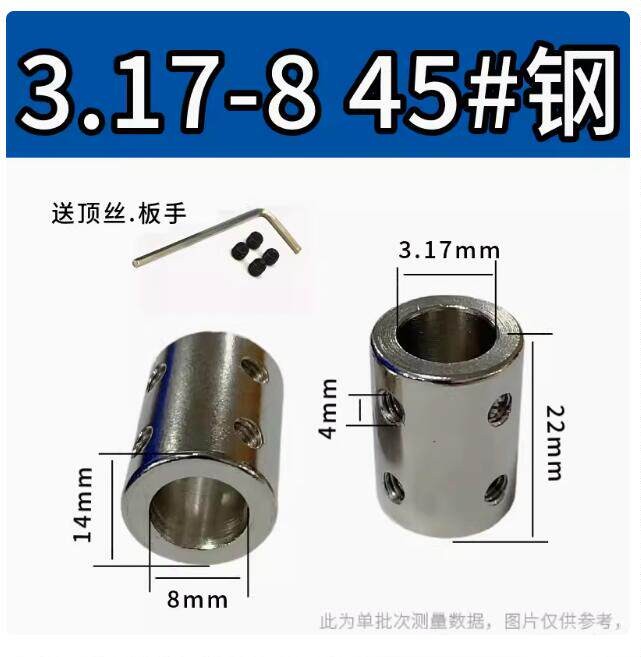
This steel coupling is the lower-priced part in the matchup and is aimed squarely at DIY machinery: 3D printers, model cars, model boats, and model airplanes. The single-piece set screw clamp design makes setup straightforward when you are joining a motor shaft to a fully threaded rod. Because the body is rigid, torque transfer is direct, with low inertia and no rotation gap, which is valuable when responsiveness matters. The trade-off is that a rigid coupling basically does not allow eccentricity. You have to spend time lining up the two shafts during installation, and any offset will fight the part. The M4 screws and compact steel body suit this to smaller DIY assemblies.
Face Flange Mounted Shaft Collar (Summit Collars)
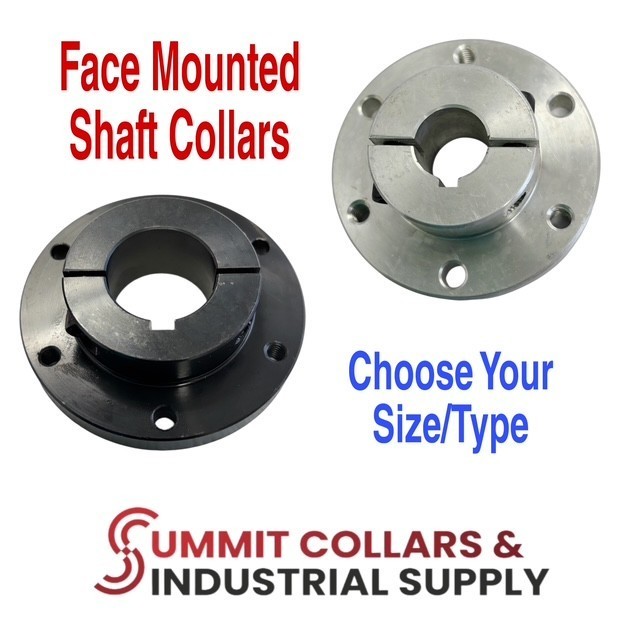
This hub-mount collar is designed to clamp around a shaft and give you a sturdy mounting surface. The layout includes three tapped counterbored holes and three unthreaded holes, so you can choose which holes work best for your bracket or hub. The collar clamps evenly around the shaft, producing a firm hold without marring the shaft surface. The aluminum black anodized version keeps weight low and adds corrosion resistance, which helps in exposed assemblies. The limitation is that this part does not join two rotating shafts end-to-end. It is a mounting and positioning collar, so use it where the shaft is already supported and you need a secure face attachment.
Final Choice by Use Case
Choose the Rigid Shaft Coupling Coupler when your priority is transferring rotation from a motor shaft to a rod in a 3D printer or model vehicle and you can align the shafts carefully. Choose the Face Flange Mounted Shaft Collar when you are working with a 1-inch shaft and need to bolt it to a fixed face or hub. Let the mounting requirement decide: a direct drivetrain connection points to the rigid coupling, while a surface-mount shaft clamp points to the face flange collar.