Industrial motors force a buyer to match more than horsepower. Frame, phase, voltage, and enclosure all have to line up, and a mismatch can cause vibration, overheating, or a motor that never starts. That kind of mismatch can end up costing more in downtime than the motor itself. That's why this 56C TEFC motor is worth a close look for anyone shopping industrial motors.
Quick verdict
If your machine needs a 2 HP three-phase motor with a face mount, an enclosed fan-cooled housing, and 230/460V wiring, this motor covers the essential requirements. The price is $176.80, which is a reasonable point for a motor with these specifications.
Who it suits
This motor is suited to industrial equipment that uses a compact C-face motor and benefits from an enclosed body. The removable base is useful if you're not mounting directly through the face, and the 60 Hz rating is aligned with standard North American power systems.
What stands out
Key specifications include Class F insulation, a 1.15 service factor, premium efficiency, and inverter duty. It accepts 208-230/460 volts, so it can handle either 230-volt or 460-volt supplies. It is also rated for 50 Hz operation with a 1.0 service factor, which widens the motor's usefulness for mixed-frequency facilities. Class F insulation is a meaningful upgrade for warm environments, and the 1.15 service factor gives a little headroom above rated load. The inverter duty rating also means the motor is designed to work with variable-frequency drives, which is useful if you plan to run it at variable speeds.
Meaningful trade-offs
The motor is three-phase only, so a single-phase shop needs a different unit unless a phase converter is added. The face pattern with a removable base provides mounting flexibility, but the frame size still has to match your equipment's bolt pattern and shaft arrangement; it's not a one-size-fits-all replacement.
Product note
56C TEFC Motor
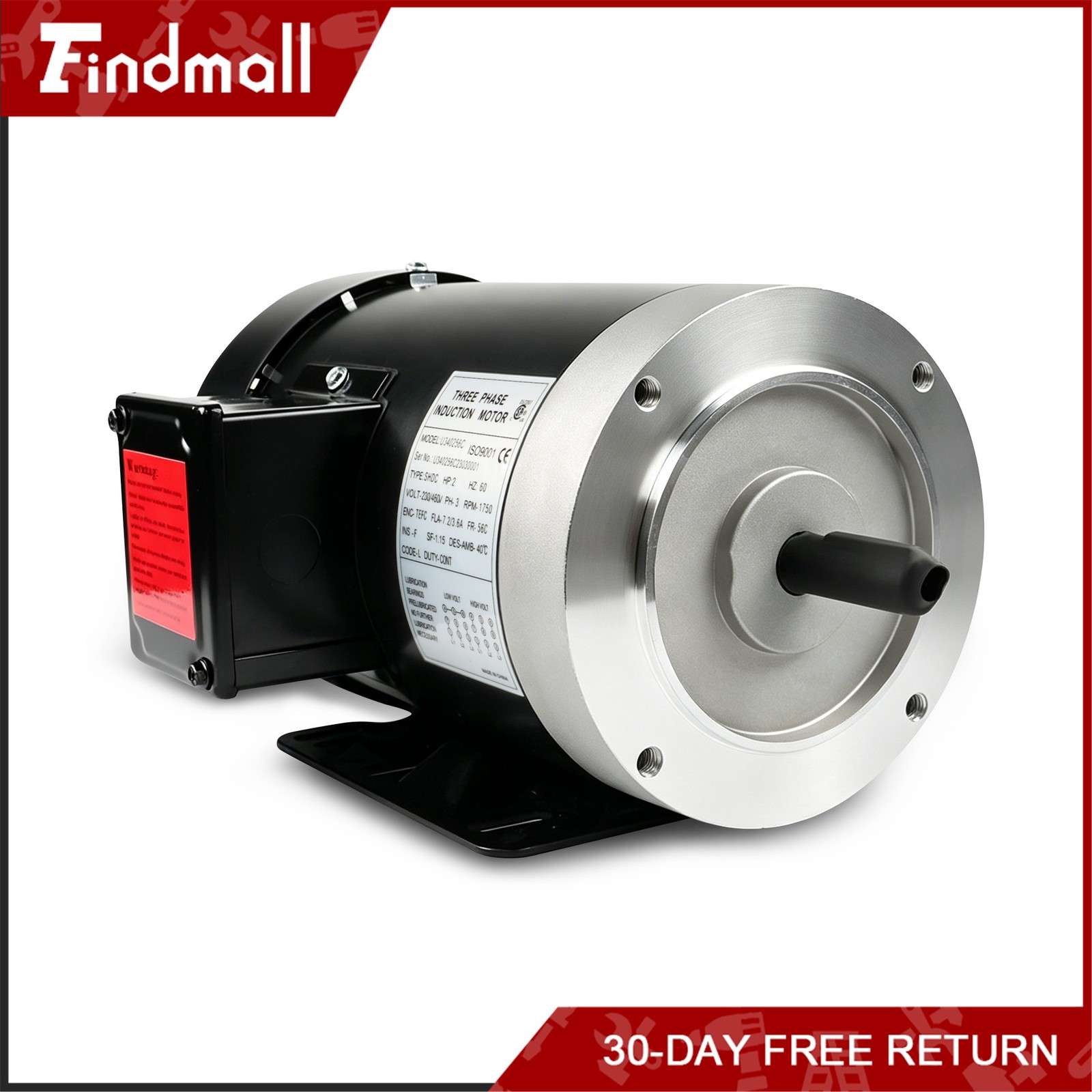
Choose it for the C-face mount and dual-voltage 230/460V wiring at $176.80. The limitation is the RPM discrepancy: the title states 1800 RPM, while the specifications state 1750 RPM, so the exact output speed is unclear.
Bottom line
For a 2 HP three-phase application that needs the right motor with the right face style, this is a strong candidate. Once the RPM question is settled, the motor should handle the core requirements without surprises.