If you're building or upgrading a compressed air system, the budget fork in the road usually looks like this: spend on a higher-volume compressor or spend on an air dryer to protect the tools and work on the other side of it. The 3 Phase 10HP Rotary Screw Air Compressor and the Schulz ADS 20 Refrigerated Compressed Air Dryer represent exactly that trade-off, and their price spread of $1,717.20 makes the decision very real.
Quick Verdict
Buy the rotary screw compressor if your system is starved for air and your electrical service can handle it. Buy the Schulz ADS 20 dryer if you already have a compressor up to 5 HP but moisture in the lines is causing headaches.
Comparison
| Consideration | 3 Phase 10HP Rotary Screw Air Compressor | Schulz ADS 20 Refrigerated Air Dryer |
|---|---|---|
| Listed price | USD 3,099.00 | USD 1,381.80 |
| Role | Air source | Air treatment |
| Airflow rating | 34 CFM | 20 CFM @ 100 PSI |
| Pressure rating | 125 PSI output | 220 PSI max input |
| Power setup | 230V 3-phase | 115V |
Where Each Wins
The rotary screw compressor wins when the job is moving enough air. It delivers high-volume, high-pressure output for sandblasters, multiple stations, and continuous-duty tools, and the fixed-speed rotary screw design is built for industrial running. Shops with heavy electrical service will have an easier time wiring it.
The Schulz ADS 20 wins when the problem is wet air. It's a refrigerated dryer that removes moisture from a compressed air line, with an electronic controller that shows temperature and dew point and times the automatic drain. That makes it the missing piece for paint work, pneumatic controls, and tools that hate water. It's also the easier install for many shops because it runs on 115V and sits downstream of a typical small compressor.
Product Notes
3 Phase 10HP Rotary Screw Air Compressor - 34 CFM, 125 PSI, 230V
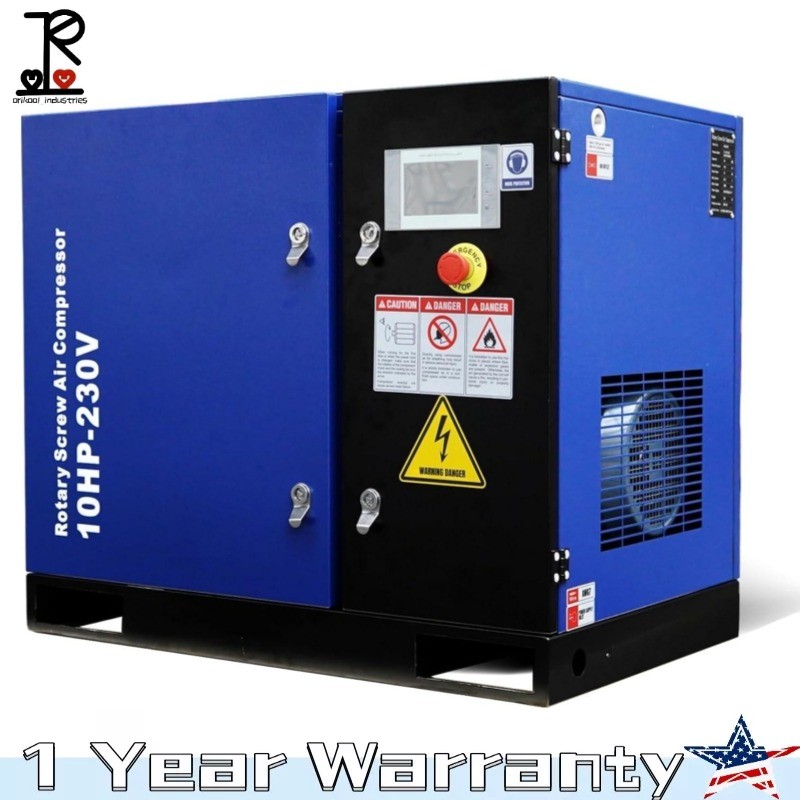
This is the primary air supplier when your shop outgrows a piston compressor. With 34 CFM of displacement and a 125 PSI exhaust pressure, it can keep up with air-hungry tools and multiple workstations. The fixed-speed rotary screw design is meant for continuous use, and the star-delta start helps manage startup current on a 230V 3-phase supply. The oil-air separator, oil gauge, and user-friendly controller make routine checks straightforward.
The limitation is the installation context: it needs 3-phase power, so it won't run in a typical residential garage or a light-commercial space with only single-phase service. And because this is a compressor, not a dryer, you'll still want to plan for moisture removal downstream if your applications are sensitive to water.
Schulz ADS 20 Refrigerated Compressed Air Dryer - 20 CFM, 115V
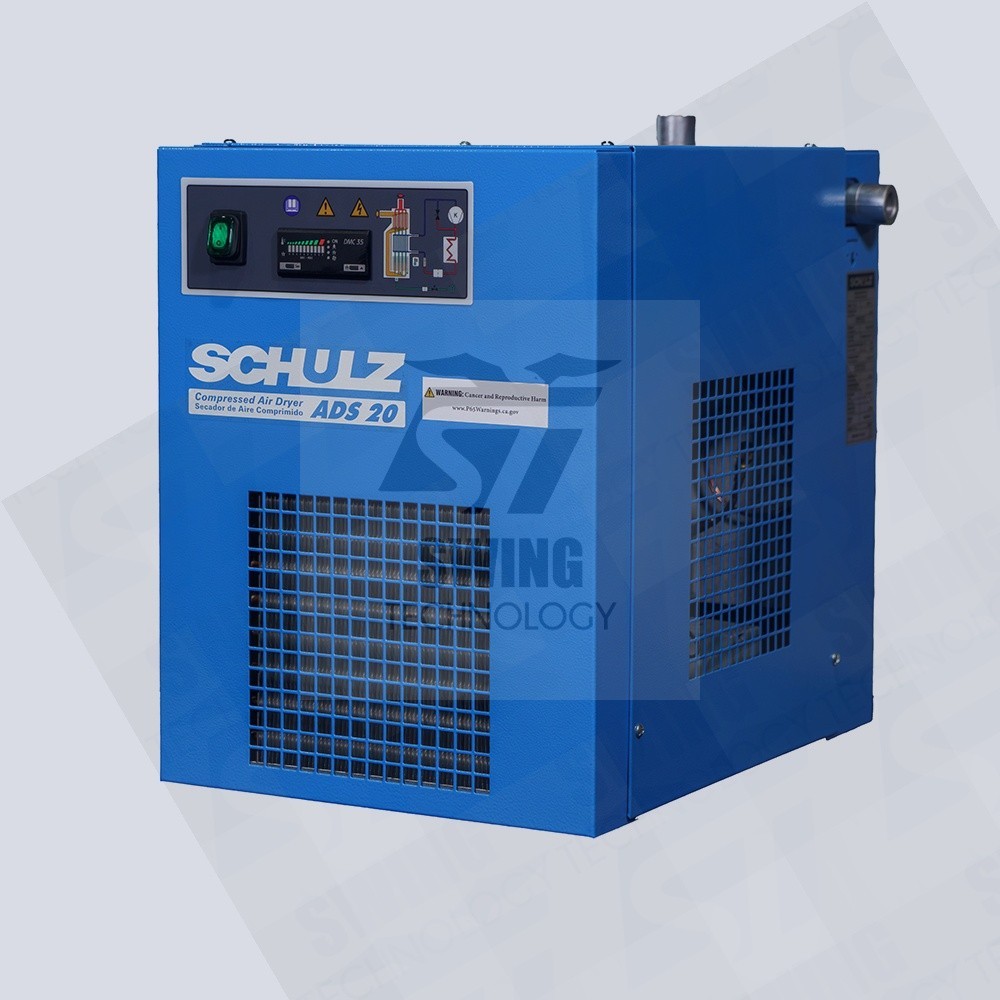
This is the moisture guard for an existing compressed air system built around a 5 HP or smaller compressor. It's a non-cycling refrigerated dryer rated for 20 CFM at 100 PSI, with a maximum input pressure of 220 PSI, so it fits between your compressor and your air tools. The integrated electronic controller monitors temperature and dew point, runs the automatic drain valve on a timer, and regulates the condenser fan only when needed.
The trade-off is that it doesn't create air; it only conditions it. If your current compressor is already straining to keep up with demand, the dryer won't add any volume. And with a 20 CFM airflow rating, it's sized for the compressor you have now-not necessarily for a larger rotary screw upgrade.
Final Choice by Use Case
Choose the 10HP rotary screw compressor if you're starting fresh and need a high-volume air source with 3-phase power available. Choose the Schulz ADS 20 dryer if you already have a compressor up to 5 HP and moisture is your bottleneck. For a complete system, the practical sequence is compressor first, dryer second-but if your air is already wet, the dryer delivers the more immediate improvement in air quality.